
On the last day of summer, I took a long walk around the former campus of the Sonoma Developmental Center (SDC). I was following up on an ongoing story about who is responsible for maintenance of the site now that the State of California, which owns the property, has stopped taking care of it. The money dried up in June, and despite repeated queries to both state and county elected officials and bureaucrats, clear answers have not been forthcoming.
The walk was lonely, hot, melancholy, and nostalgic. I’m a fan of places with long histories, especially when they show their age. The evolution of the Eldridge campus from abandoned to haunting in these last few months has lent it a sweet vulnerability.
With the water shut down, the once-manicured lawns have blistered brown in the sun — except where the pipes leak. A tangled streak of greenery connects a fire hydrant to the foundation of the shuttered Butler building. Broken branches are heaped on the unkempt lawns, on the sidewalks, on the rooftops. Weeds spring from the cracks in the pavement. Windows are broken, gates hang open, brambles crowd the walkways.
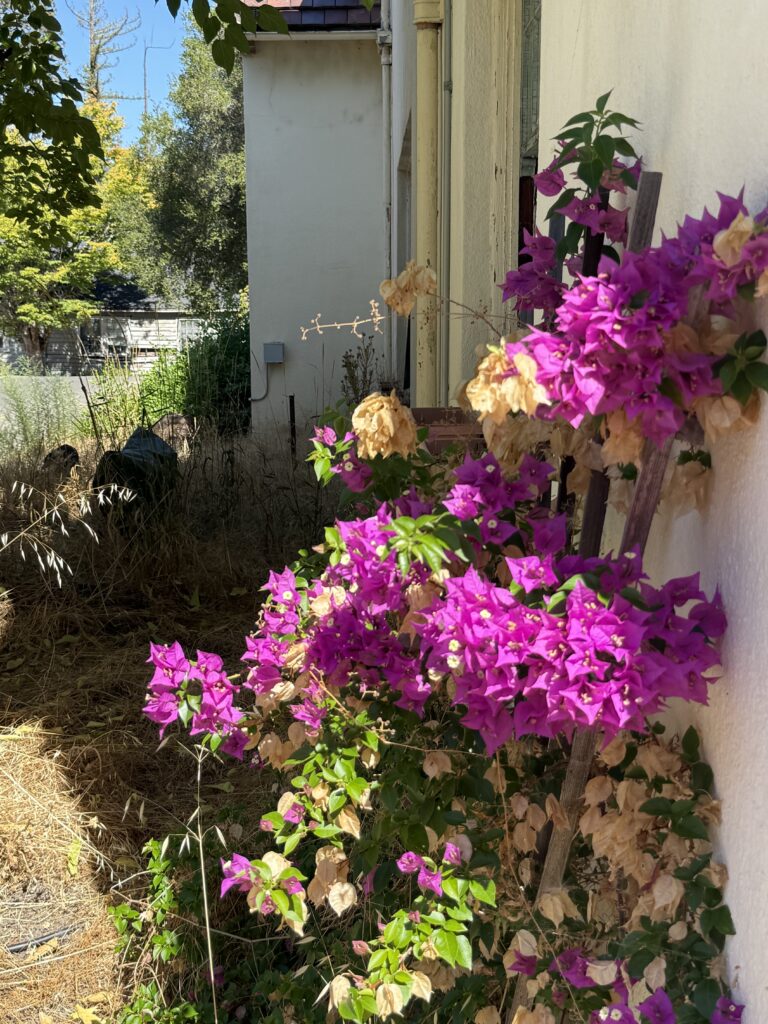
Two flashes of pink catch my eye. One is graffiti that sags with the windowpanes it has been spray-painted across. The other is bougainvillea that somehow, despite being parched and neglected, wraps its vivid blooms around a corner of the Hatch residence.
I make a slow circuit of Sonoma House, which is the main reason I’m following up on the story. Others have been walking in Eldridge as well, and they’ve expressed concerns about the plastic sheeting draped over the venerable Victorian’s complicated rooftop to keep out the rain. The sheeting has begun to disintegrate, shreds of plastic littering the ground and twining in the untended verge.
In a letter sent to Gerald McLaughlin at the state’s Department of General Services (DGS), Valley resident David Eichar lamented the current conditions. “I am greatly concerned that when it rains, which has already started, the plastic will break down further and end up in Sonoma Creek, becoming an environmental hazard,” he wrote.
“Aware of the situation,” McLaughlin responded, briefly explaining that contractors hired to protect the roof wouldn’t “warranty” the sheeting material. “Working on getting the loose plastic picked up.”
I tried to see if any of the shredded sheeting still strewn about the house had drifted into burbling Mill Creek, just 50 yards or so away, but the creekbank was too overgrown to penetrate. The plastic still slung over the roof was sun-bleached, crispy, and drooping, as was the exterior of the building itself, paint blistering, corners sagging, shingles hanging askew.
Prompted by Eichar, as well as the observations of the dauntless Alice Horowitz, curator of the Eldridge for All website, and Teresa Murphy of the Glen Ellen Historical Society, who laments the neglect in a letter to the editor, I renewed my queries to the powers-that-be: officials at DGS (Gerald McLaughlin among them); officials at Sonoma County, including Supervisor Rebecca Hermosillo; State Assemblymember Damon Connolly; and State Senator Chris Cabaldon. I asked for clarity on who’d take responsibility for landscape maintenance (e.g., clearing fallen trees, cutting the grass, etc.), and for building and infrastructure maintenance (e.g., fixing broken pipes, broken glass, graffiti removal, etc.)? I asked about the leak in front of the Butler Building. I asked about maintenance of the Sonoma House and trash pickup. I asked how long 24-hour campus security will be present, and who is paying the bill.
Matt Brown, County communications specialist, responded promptly with essentially the same answer we’ve been given since we first starting reporting on the story in May: “As the property owner, the State Department of General Services is responsible for maintenance of the Sonoma Developmental Center campus. When the County is made aware of issues, we reach out to our partners at DGS so that they can address them.
When I followed up with a question about whether the County and State had finalized a collaborative agreement regarding site maintenance, Brown replied, “There is no written agreement. When the County is made aware of issues at the SDC property, we communicate with our partners at the State DGS. In that sense, the communication is ongoing.”
Monica Hassan, deputy director with DGS, responded on behalf of the State. “The State currently owns the SDC property,” she confirmed via email. “DGS has made provisions for 24/7 security guard services. The State also continues to coordinate as needed with Sonoma Valley Fire Department to facilitate the fire department’s ability to provide fire response for the SDC property.”
Since that didn’t answer the questions about landscape and building maintenance, I followed up: “Given there are clear infrastructure issues that need attention, who should I talk to at the state about when repairs will be made and when landscaping upkeep will be performed?”
Hassan replied, “The SDC property is currently subject to a disposition process pursuant to state law as well as being the subject of several lawsuits. Therefore, the State is unable to provide additional information regarding the specific structures or features of the property at this time, as these matters are currently pending.”
Well, that was new. Clearly the lawsuit excuse means the State will divulge nothing more about timelines or its responsibilities on the property.
Teresa Murphy, in her letter, wonders whether the neglect is purposeful. I have to wonder the same thing.
But for what purpose? Is it to punish a community so frustrated with the redevelopment process that it has turned to the courts to be heard? Is it to make the property so dangerous that the community will fall out of love with it and stop fighting for it? (That ain’t gonna happen.)
And seriously: How does running a lawnmower or paying for trash collection affect the outcome of a lawsuit?
But the bigger question is: What now? What happens when a tree falls across Arnold Drive? Who pays for the wasted water? We’ve got fire response, but what about fire prevention?
Talk about liability …
The beauty of the rewilding campus, even as the garbage cans overflow and the trees drop branches onto the rooftops, remains profound. As I walk and document and consider tactics and cry for shame, I also think about my responsibility to the place, the reciprocity I can commit to for its gifts. I cannot replace plastic sheeting; I cannot reglaze windows or replace shingles. But I can pick up plastic. I can bring water to the bougainvillea.
And I can keep asking questions.